AI
AI vs Human Writing: Which Ranks Better on Google? (2026 Study)
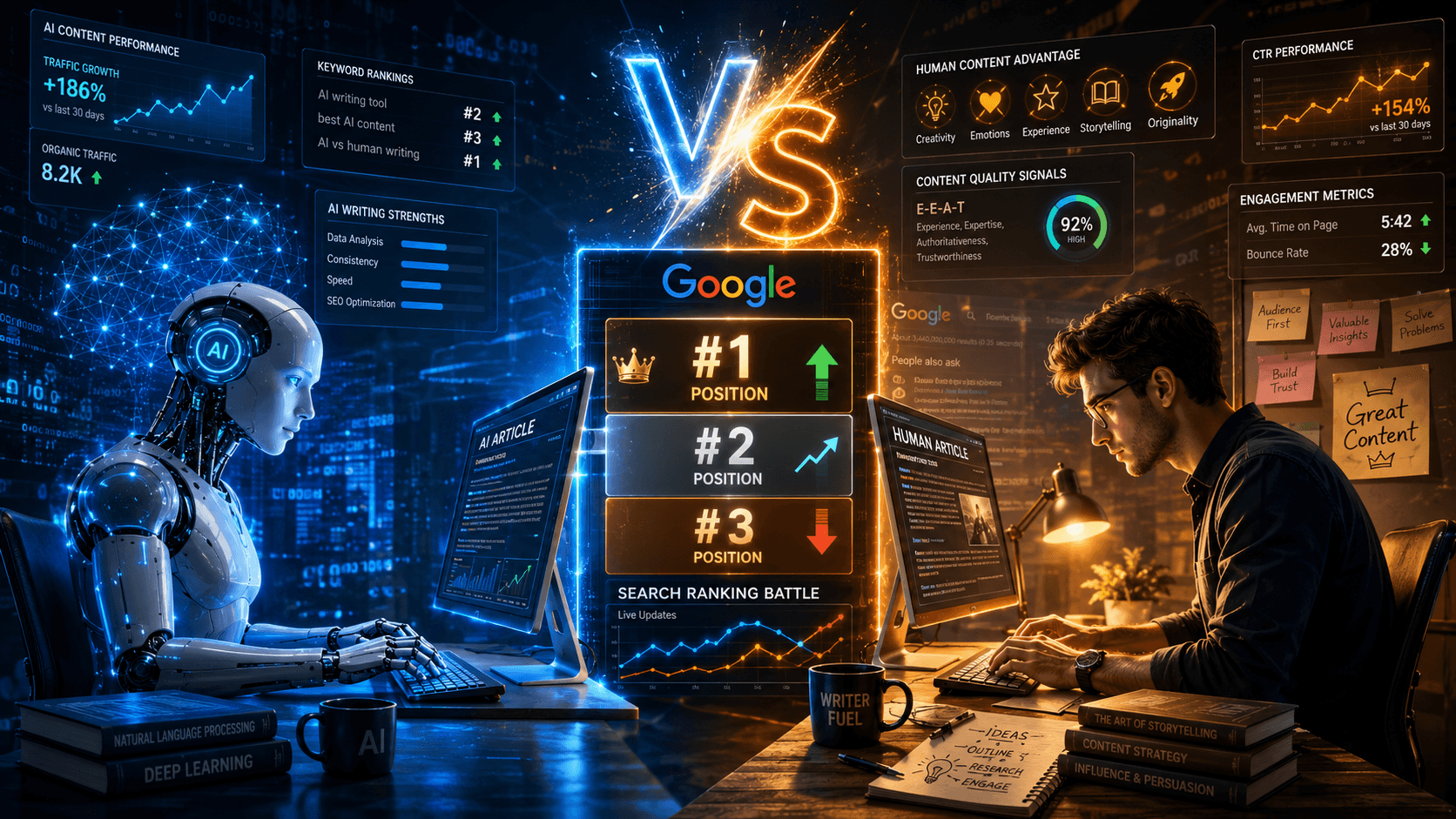
AI vs Human Writing: Which Ranks Better on Google?
Quick Answer
Yes, AI-generated content can rank on Google.
But when it comes to highly competitive keywords, long-term ranking stability, backlink acquisition, and top-position dominance, human-written content still performs better.
The real winner in 2026 isn't AI-only content or human-only content.
It's human-led, AI-assisted content.
That's the approach used by most successful publishers, SaaS companies, SEO agencies, and enterprise brands today.
Introduction
A few years ago, the debate was simple:
Can AI content rank on Google?
Today, the question has evolved.
Millions of AI-generated articles are published every month. Businesses are using ChatGPT, Claude, Gemini, and dozens of AI writing tools to scale content production faster than ever before.
At the same time, Google has released multiple Helpful Content updates, SpamBrain enhancements, and AI-focused algorithm changes designed to reward quality while reducing low-value content.
This has left website owners wondering:
Does Google penalise AI content?
Is human writing still better?
Can AI-generated articles reach Page 1?
What does Google actually want?
Which approach delivers the best SEO results?
This guide examines the evidence, Google's official position, real-world studies, and ranking data to answer one question:
AI vs Human Writing: Which ranks better on Google?
The Short Answer: Both Can Rank
Let's clear up the biggest myth first.
Google does not automatically penalise AI-generated content.
If that were true, millions of pages currently ranking on Google would disappear overnight.
Google's position is straightforward:
The search engine evaluates content quality—not whether a human or an AI created it.
In other words:
Google cares about:
Helpfulness
Accuracy
Expertise
Originality
User satisfaction
Google does not care whether the first draft came from a person or an AI tool.
This distinction is critical.
Many website owners mistakenly believe AI content is automatically spam.
That's simply not true.
Low-quality content is spam.
The tool used to create it is irrelevant.
Google's Official Position on AI Content
Google has repeatedly stated that AI-generated content is acceptable.
The company's guidance focuses on the quality of the final output rather than the production method.
According to Google's search quality principles, content should demonstrate:
Experience
Expertise
Authoritativeness
Trustworthiness
Collectively known as E-E-A-T.
If AI helps produce useful content that satisfies user intent, Google has no issue with it.
However, Google strongly opposes using AI to mass-produce low-value pages purely to manipulate rankings.
This is where many publishers get into trouble.
Why Many People Think Google Penalises AI Content
The confusion comes from Google's spam policies.
Google doesn't penalise AI.
Google penalises scaled content abuse.
These are not the same thing.
Imagine a website publishes:
5,000 AI-generated articles
No editing
No expertise
No original insights
No fact-checking
The goal isn't helping users.
The goal is to manipulate search rankings.
That's exactly the type of content Google's spam systems target.
Many website owners see those sites lose rankings and conclude:
"Google penalised AI."
What actually happened is:
Google penalises low-quality content.
The AI tool itself wasn't the problem.
Why Human Content Still Dominates Competitive Rankings
Although AI content can rank, studies consistently show that human-written content dominates the most valuable search positions.
Why?
Because ranking at the top of Google requires more than simply answering a question.
It requires trust.
Human writers bring several advantages that AI cannot naturally replicate.
Advantage #1: Original Experience
The first "E" in E-E-A-T stands for Experience.
Google increasingly rewards content created by people who have actually done the thing they're writing about.
For example:
A person can write:
"I tested 15 project management tools for three months and found that ClickUp worked best for small teams."
AI cannot genuinely make that claim.
It can only imitate similar language.
Google's systems increasingly reward firsthand experience because it provides information users cannot find elsewhere.
This is one of the biggest reasons human content continues to dominate competitive niches.
Advantage #2: Original Data
AI models are trained on existing information.
They cannot create genuinely new research.
Humans can.
Examples include:
Original surveys
Industry studies
Case studies
Customer interviews
Product testing
Internal company data
Google values information gain.
Information gain means adding something new to the internet.
A page that introduces original data is far more valuable than a page that simply rewrites existing content.
Advantage #3: Better Backlink Acquisition
Backlinks remain one of Google's strongest ranking signals.
People naturally link to:
Research
Statistics
Expert opinions
Case studies
Unique insights
Human-created content earns significantly more backlinks because it offers something worth citing.
AI-generated content tends to summarise information already available elsewhere.
As a result, it often struggles to attract editorial links.
This creates a compounding SEO advantage for human-authored content.
More links lead to higher authority.
Higher authority leads to better rankings.
Better rankings attract more links.
The cycle continues.
Advantage #4: Stronger User Engagement
Google pays close attention to user behaviour.
Important signals include:
Time on page
Scroll depth
Engagement
Return visits
Human writers excel at storytelling.
They understand emotion.
They know how to create curiosity.
They can inject humour, personal experiences, and relatable examples.
AI often produces content that is technically correct but emotionally flat.
Readers notice the difference.
And Google's systems increasingly notice it too.
Where AI Content Performs Surprisingly Well
Despite its limitations, AI has several major advantages.
These advantages explain why AI-generated content continues to appear throughout Google's search results.
AI Advantage #1: Speed
AI can generate thousands of words in minutes.
A human writer may spend:
Hours researching
Hours outlining
Hours drafting
Hours editing
AI dramatically accelerates these processes.
For businesses producing large volumes of content, this efficiency is extremely valuable.
AI Advantage #2: Scalability
A single AI system can create:
Blog drafts
Product descriptions
Category pages
FAQs
Meta descriptions
at a scale impossible for most human teams.
This allows companies to build topical authority much faster.
AI Advantage #3: Cost Efficiency
Hiring expert writers is expensive.
AI tools cost a fraction of that amount.
For startups and small businesses, AI dramatically lowers content production costs.
This makes content marketing accessible to organisations that otherwise couldn't compete.
AI Advantage #4: Structural SEO
AI is surprisingly good at:
Outlines
Content organization
Semantic keyword coverage
Heading structures
FAQ generation
Schema markup
These technical SEO elements are important for rankings.
AI can handle them efficiently and consistently.
Head-to-Head Comparison
Search Rankings
AI content can rank.
Human content tends to dominate the highest positions.
Originality
AI recombines existing information.
Humans create new information.
Expertise
AI simulates expertise.
Humans demonstrate expertise.
Engagement
AI often feels generic.
Humans create emotional connections.
Cost
AI is significantly cheaper.
Humans are more expensive.
Scalability
AI wins easily.
Human production is limited by time and resources.
Long-Term SEO Value
Human content generally delivers stronger long-term performance.
What Actually Determines Rankings?
The AI vs Human debate often misses the bigger picture.
Google doesn't rank content based on who wrote it.
Google ranks content based on usefulness.
Several factors matter far more than authorship.
Search Intent Satisfaction
The most important ranking factor is satisfying user intent.
If someone searches:
"How do I reset my iPhone?"
A concise AI-generated answer may outperform a 4,000-word human essay.
The best content solves the user's problem quickly and accurately.
Topical Authority
Google prefers websites that demonstrate expertise across an entire topic.
This means creating:
Pillar content
Supporting articles
Internal links
Semantic coverage
Whether AI or humans write the content is less important than building comprehensive topical authority.
Content Depth
Google rewards comprehensive coverage.
The strongest pages answer:
Primary questions
Related questions
Follow-up questions
They cover the topic completely.
Depth matters.
Thin content struggles regardless of who created it.
Backlinks
Backlinks remain critical.
This is where human content often gains an advantage.
Original insights attract links.
Generic summaries do not.
E-E-A-T Signals
Google wants evidence of:
Experience
Expertise
Authority
Trust
Pages with:
Expert authors
Real credentials
Original research
Transparent sourcing
typically performs better.
The Rise of the Hybrid Content Model
The most successful SEO teams have already moved beyond the AI vs Human debate.
Instead, they use both.
This approach combines the strengths of each.
Step 1: AI Handles Research and Structure
AI helps with:
Topic clustering
Outline creation
SERP analysis
Semantic keyword discovery
This saves hours of manual work.
Step 2: AI Creates the First Draft
The AI generates:
Initial copy
Headers
FAQs
Supporting sections
This dramatically increases content velocity.
Step 3: Humans Add Expertise
Subject matter experts then:
Rewrite key sections
Add experience
Insert examples
Include original data
Improve accuracy
This is where the real value is created.
Step 4: Human Editors Optimise Quality
Editors verify:
Facts
Sources
Flow
Readability
Search intent alignment
The final result combines AI efficiency with human expertise.
Why Hybrid Content Wins
The hybrid model solves the biggest problems associated with both approaches.
AI provides:
Speed
Scale
Efficiency
Humans provide:
Trust
Expertise
Originality
Together, they create content that performs exceptionally well in search.
This is why most high-performing SEO teams now use AI as an assistant rather than a replacement.
The Future of Google Search
Search is changing rapidly.
Google's AI Overviews and generative search features increasingly answer questions directly inside search results.
This means websites can no longer compete by publishing generic information.
Commodity content is becoming less valuable.
The future belongs to content that offers:
Original research
Expert opinions
Unique frameworks
Firsthand experience
Proprietary data
These are things AI cannot easily replicate.
As AI-generated content becomes more common, authentic expertise becomes more valuable.
Not less.
Frequently Asked Questions
Does Google penalise AI-generated content?
No.
Google evaluates quality, not production methods.
However, low-quality AI content can be penalised under spam policies.
Can AI content rank on Google?
Yes.
Many AI-assisted and AI-generated pages rank successfully.
Is human writing better for SEO?
Generally, yes, especially for competitive keywords where expertise, authority, and originality matter.
What is the best SEO content strategy?
A hybrid approach that combines AI efficiency with human expertise.
Will AI replace human writers?
AI will replace some repetitive writing tasks.
However, human expertise, creativity, and original insight remain essential for high-performing content.
Final Verdict
So, AI vs Human Writing: Which ranks better on Google?
The answer is clear.
Human-written content still performs better at the highest levels of search.
It earns more backlinks.
It demonstrates stronger E-E-A-T signals.
It provides original experiences and unique insights that AI cannot naturally generate.
However, AI has become an incredibly powerful content creation tool.
It accelerates research, improves efficiency, and helps teams scale content production faster than ever before.
The biggest SEO winners in 2026 are not choosing between AI and human writers.
They're combining both.
AI handles the repetitive work.
Humans provide the expertise, originality, and trust that Google's algorithms increasingly reward.
In other words:
AI creates content faster. Human expertise makes it rank.
Newsletter
Get New Posts In Your Inbox
No spam. Just practical reads on AI, Finance, and Tech.
By subscribing, you agree to get occasional emails. Every one has a one-click unsubscribe link.