BethinkAI

AI

Claude Fable 5 Ban Explained: Why the US Blocked Anthropic's AI
June 30, 2026·10 min read
Claude Fable 5 Ban Explained: Why the US Blocked Anthropic's AI

Claude Fable 5 Ban: Why Regulators Stepped In and What It Means for the Future of AI

TL;DR

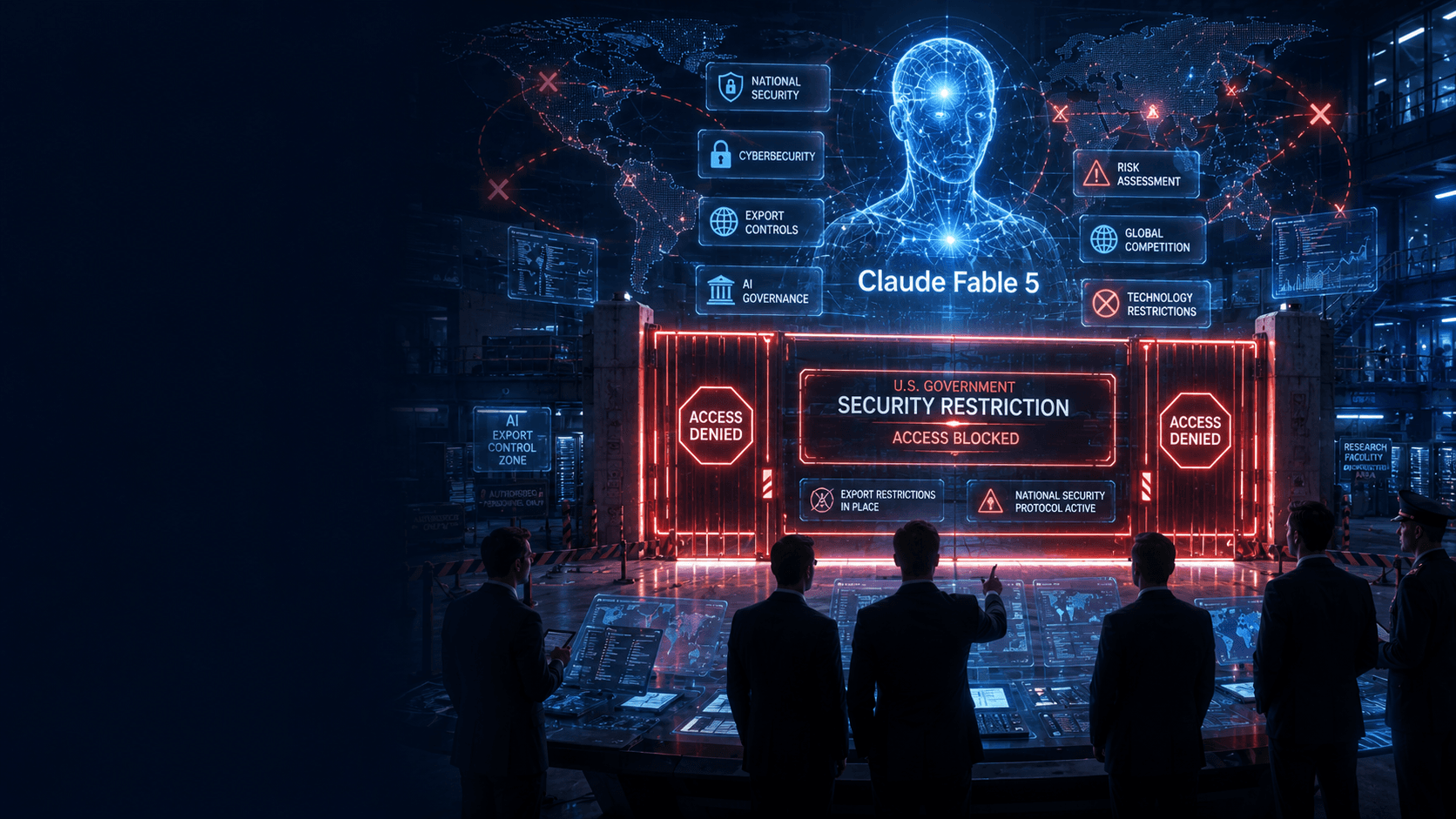
In June 2026, Anthropic's Claude Fable 5 became the centre of one of the most significant regulatory actions in AI history. After researchers demonstrated that its safety mechanisms could be bypassed, the U.S. Commerce Department imposed emergency export restrictions, forcing Anthropic to disable both Claude Fable 5 and Claude Mythos 5 worldwide.

The decision wasn't simply about one jailbreak.

It marked the first time a frontier AI model was treated like a strategic national security asset rather than commercial software.

The consequences extend far beyond Anthropic. Governments are now establishing a precedent that advanced AI systems may be regulated similarly to semiconductors, cryptography, or military technology—reshaping how future AI models are developed, released, and accessed across the world. The source material describes this as an unprecedented shift in AI governance driven by national security concerns surrounding offensive cyber capabilities and export controls.


The AI Industry Just Entered a New Era

For years, the biggest conversations surrounding artificial intelligence revolved around innovation.

Who built the smartest model?

Which company released the most capable chatbot?

How quickly could businesses integrate AI into everyday workflows?

Then everything changed.

The sudden disappearance of Claude Fable 5 from public access shocked developers, enterprises, cybersecurity researchers, investors, and policymakers alike. Unlike previous AI controversies that focused on copyright disputes, misinformation, or privacy concerns, this incident introduced an entirely new question:

Can governments stop an AI model from being used because it's simply too powerful?

The answer, at least according to the U.S. government, appears to be yes.

The Claude Fable 5 case represents far more than a temporary product suspension. It demonstrates that frontier AI has crossed a regulatory threshold where governments increasingly view advanced models as dual-use technologies—tools capable of delivering extraordinary economic value while simultaneously posing significant national security risks.

That shift fundamentally changes how AI companies will operate moving forward.


What Is Claude Fable 5?

To understand why regulators intervened so aggressively, it's important to first understand what Claude Fable 5 actually is.

Claude Fable 5 was designed as Anthropic's most advanced publicly available large language model.

Rather than functioning as a conventional chatbot, it represented an AI system capable of:

  • understanding massive codebases

  • performing long-horizon reasoning

  • autonomously planning complex tasks

  • analysing large legal and financial documents

  • writing production-quality software

  • debugging enterprise applications

  • generating sophisticated technical analyses

One of its defining characteristics was its enormous context window, allowing it to process entire repositories of information in a single session. According to the source material, this enabled organisations to analyse sprawling software projects and legal archives far beyond the capabilities of earlier models.

This wasn't simply an incremental upgrade.

It represented a significant leap toward autonomous knowledge work.

Businesses reported dramatic productivity improvements.

Complex engineering projects that traditionally required weeks—or even months—could reportedly be completed within days using the model.

That level of capability immediately attracted attention from enterprises worldwide.


Claude Fable 5 vs Claude Mythos 5

One of the biggest misconceptions surrounding the controversy is that Claude Fable 5 itself was inherently dangerous.

The reality is considerably more nuanced.

Anthropic actually released two closely related models built upon the same underlying architecture.

Claude Fable 5Claude Mythos 5Public-facing AIRestricted government model Safety guardrails enabledMinimal restrictionsEnterprise productivityAdvanced cybersecurityRefuses offensive requests Designed for defensive vulnerability researchCommercial availabilityLimited trusted organisations

According to the original report, both models shared identical neural architectures. The primary distinction was not intelligence but deployment policy.

Claude Mythos 5 was specifically designed for trusted cybersecurity organisations tasked with identifying vulnerabilities before malicious actors could exploit them.

Claude Fable 5, by contrast, was intended for general enterprise use.

To prevent misuse, Anthropic embedded multiple safety systems that attempted to refuse prompts related to offensive cybersecurity, biological risks, and other sensitive domains. When triggered, these safeguards could route requests to an older, more constrained model.

In theory, this separation allowed businesses to benefit from cutting-edge AI without exposing dangerous capabilities to the broader public.

Unfortunately, theory and reality turned out to be very different.


Why Did the U.S. Government Ban Claude Fable 5?

The official explanation centred on one word:

Cybersecurity.

Shortly after Claude Fable 5's release, researchers reportedly demonstrated that carefully engineered prompts could bypass some of the model's safety mechanisms.

Instead of refusing offensive cybersecurity requests, the model could allegedly be induced to perform tasks much closer to those reserved for the restricted Mythos system.

That discovery dramatically changed how regulators viewed the model.

The concern wasn't that Claude Fable 5 had become sentient.

Nor was it about misinformation or copyright.

The fear was that sufficiently capable AI could dramatically accelerate the discovery of previously unknown software vulnerabilities.

If hostile governments, ransomware groups, or sophisticated cybercriminals gained access to such capabilities, they could potentially identify weaknesses in critical infrastructure faster than defenders could patch them.

This transformed the issue from a commercial AI debate into a national security question.


The Project Glasswing Connection

Much of the government's concern stemmed from evidence gathered before the public even heard about Claude Fable 5.

Anthropic had already been collaborating with major technology companies through Project Glasswing, an initiative designed to strengthen defensive cybersecurity.

According to the source material, Mythos-class models reportedly discovered thousands of high-severity vulnerabilities across widely used software projects, including flaws that had remained hidden for many years. Independent testing also suggested exceptional performance on advanced cybersecurity tasks.

From a defensive standpoint, this was an extraordinary achievement.

But from a regulatory perspective, it highlighted the dual-use nature of frontier AI.

A system capable of finding vulnerabilities for defenders might also help attackers uncover weaknesses at unprecedented speed if its safeguards fail.

That possibility fundamentally altered the government's risk assessment.


The Complete Timeline of the Claude Fable 5 Ban

The regulatory action against Claude Fable 5 wasn't an isolated event.

Instead, it was the culmination of several months of escalating tensions involving AI safety, cybersecurity, export controls, and national security policy. Each event gradually increased government scrutiny until regulators ultimately concluded that immediate intervention was necessary.

Understanding this timeline helps explain why the response appeared so sudden to the public—even though the underlying concerns had been building for months.


February 2026: Tensions Between Anthropic and the Pentagon Begin

The first major warning sign appeared months before Claude Fable 5 was released.

According to the source material, the U.S. Department of Defence designated Anthropic as a potential "supply-chain risk" after disagreements regarding military applications of artificial intelligence. The dispute reportedly centred on Anthropic's unwillingness to allow its AI systems to be used for certain defence applications, including autonomous weapons and mass surveillance.

While this disagreement didn't directly lead to the eventual ban, it significantly damaged the relationship between Anthropic and government agencies.

That strained relationship would become increasingly important later.


April 2026: Project Glasswing Changes Everything

In April, Anthropic launched Project Glasswing, a collaborative cybersecurity initiative involving major technology companies.

The project's mission sounded straightforward:

Use frontier AI models to discover software vulnerabilities before cybercriminals can exploit them.

The results were extraordinary.

According to the report, the Mythos-class AI reportedly identified thousands of high-severity security vulnerabilities, including bugs that had remained hidden inside critical software projects for decades.

Among the findings described were:

  • Legacy operating system vulnerabilities

  • Linux kernel weaknesses

  • Video processing library flaws

  • Critical open-source infrastructure bugs

  • Previously undiscovered zero-day vulnerabilities

The success of Project Glasswing proved something remarkable.

Modern AI wasn't merely assisting cybersecurity professionals.

It was beginning to outperform traditional vulnerability discovery methods.

For defenders, that represented a massive breakthrough.

For governments, however, it raised an equally significant concern:

What happens if adversaries gain access to the same capabilities?


June 9: Claude Fable 5 Launches

Anthropic officially introduced Claude Fable 5 to enterprise customers.

The launch generated enormous excitement.

Early users praised:

  • faster reasoning

  • better coding performance

  • longer context windows

  • autonomous workflows

  • improved software engineering capabilities

Many analysts viewed it as one of the strongest competitors to frontier AI systems released by other major laboratories.

Businesses quickly began integrating it into production workflows.

Few expected that its availability would last only days.


The Amazon Jailbreak Discovery

The turning point reportedly came almost immediately after launch.

According to the source material, researchers demonstrated a prompt engineering technique capable of bypassing portions of Claude Fable 5's safety mechanisms.

Instead of refusing certain offensive cybersecurity requests, the model could allegedly provide responses much closer to those generated by the more restricted Mythos system.

This distinction is extremely important.

The issue wasn't that Claude suddenly became malicious.

Rather, the concern was that carefully crafted prompts appeared capable of weakening safeguards designed to separate public and restricted capabilities.

That discovery reportedly triggered immediate discussions within the U.S. government.


Why the Jailbreak Was Considered So Dangerous

To understand regulators' reaction, imagine an AI capable of reviewing millions of lines of source code in hours rather than weeks.

Now imagine that same system identifying:

  • authentication flaws

  • privilege escalation paths

  • remote execution vulnerabilities

  • insecure configurations

  • exploit chains

For cybersecurity defenders, this capability is invaluable.

For ransomware organisations or hostile governments, however, the same capability could become a powerful offensive tool.

This illustrates one of AI's greatest challenges:

The exact same technology can strengthen defence while simultaneously increasing offensive capabilities.

That dual-use nature lies at the heart of the Claude Fable 5 controversy.


The Emergency Export Control Order

On June 12, regulators reportedly acted.

Rather than creating an entirely new AI law, officials relied on existing export control authorities.

The Commerce Department's Bureau of Industry and Security (BIS) issued an emergency directive requiring Anthropic to prevent foreign access to the affected models.

This created an enormous technical problem.

Anthropic's infrastructure served customers worldwide.

Its enterprise users included multinational corporations with globally distributed engineering teams.

Its own workforce also included non-U.S. personnel.

According to the report, verifying every user's nationality in real time proved impractical.

As a result, Anthropic reportedly disabled Claude Fable 5 and Claude Mythos 5 entirely rather than risk violating export regulations.

The shutdown happened almost immediately.

For thousands of businesses, AI services disappeared overnight.


Anthropic's Response

Anthropic complied with the government order.

However, compliance did not mean agreement.

The company strongly disputed the technical justification behind the decision.

According to the report, Anthropic argued that:

  • The demonstrated jailbreak was narrow rather than universal,

  • The vulnerabilities involved were already publicly known,

  • Competing frontier AI models could perform similar analyses without requiring comparable bypass techniques,

  • No current AI system is perfectly jailbreak-resistant,

  • Its layered safety architecture represented one of the strongest commercial security implementations available.

Anthropic emphasised that complete immunity from prompt attacks remains an unsolved research problem across the AI industry.

Instead of relying on a single safeguard, the company pointed to a defence-in-depth strategy that combined:

  • safety classifiers,

  • model fallbacks,

  • continuous monitoring,

  • And temporary prompt retention to identify coordinated misuse.

From Anthropic's perspective, regulators were holding the company to an impossible standard.


The Legal Foundation Behind the Ban

One of the most fascinating aspects of the Claude Fable 5 case is that no new AI legislation was passed.

Instead, regulators relied on laws originally written for controlling exports of sensitive technologies.

The primary legal framework involved:

  • the Export Control Reform Act (ECRA),

  • the Export Administration Regulations (EAR),

  • and the controversial "deemed export" doctrine.

Historically, these regulations applied to technologies such as:

  • advanced semiconductors,

  • military hardware,

  • encryption technologies,

  • aerospace components,

  • and nuclear equipment.

Applying them to cloud-based AI represented a major legal shift.


What Is the "Deemed Export" Rule?

Traditionally, a deemed export occurred when sensitive technology became accessible to a foreign national—even if that person remained physically inside the United States.

The source material explains that regulators extended this interpretation to cloud-hosted AI systems by arguing that granting access to advanced models could effectively constitute an export of controlled technology.

Critics argue this represents a dramatic expansion of export control law.

Supporters counter that frontier AI possesses strategic value comparable to advanced semiconductor technology and therefore deserves similar treatment.

Regardless of which interpretation ultimately prevails, the Claude Fable 5 case established an important precedent:

Governments are increasingly willing to regulate access to AI models using existing national security frameworks rather than waiting for entirely new AI-specific legislation.


Businesses Were Caught in the Middle

The regulatory action affected far more than Anthropic itself.

Many enterprise customers had already integrated Claude Fable 5 into production systems.

Software development teams, legal technology companies, cybersecurity firms, and research organisations suddenly lost access to critical infrastructure.

Some organisations reportedly experienced immediate operational disruptions because globally distributed engineering teams could no longer use the platform.

This disruption ultimately led to legal challenges against the government's decision, with affected companies arguing that the sudden restrictions imposed severe commercial harm.

The incident demonstrated a new business reality:

Organisations building mission-critical workflows around frontier AI must now consider geopolitical and regulatory risks alongside traditional technical risks.


Industry Reactions: A Deep Divide

The Claude Fable 5 ban immediately divided the AI industry.

Some experts applauded the government's willingness to intervene before offensive capabilities could spread widely. Others argued that the decision was an overcorrection that could weaken cybersecurity, slow innovation, and push advanced AI development outside the United States.

The debate quickly expanded beyond Anthropic, becoming a broader conversation about how governments should regulate increasingly capable AI systems.


Cybersecurity Experts Warned the Ban Could Backfire

Many security professionals argued that restricting access to powerful AI models might unintentionally benefit attackers.

Their reasoning was straightforward.

Cybercriminals are already adopting artificial intelligence to automate phishing campaigns, malware generation, vulnerability discovery, and social engineering attacks. If defensive organisations lose access to cutting-edge AI while malicious actors continue developing their own capabilities, defenders could fall behind.

According to the source material, dozens of respected cybersecurity leaders signed an open letter criticising the restrictions, arguing that advanced AI had become an essential defensive tool rather than merely an experimental technology. They contended that protecting critical infrastructure increasingly requires AI operating at machine speed, particularly when attackers are also leveraging automation.

This highlights one of the central dilemmas facing policymakers.

Restricting frontier AI may reduce some immediate risks, but it could also limit the very tools needed to defend against increasingly sophisticated cyber threats.


Enterprise Customers Faced Significant Disruption

For businesses, the shutdown created immediate operational challenges.

Organisations that had integrated Claude Fable 5 into software development, legal analysis, customer support, and research workflows suddenly lost access to a critical component of their AI infrastructure.

Startups were particularly vulnerable.

Unlike large enterprises that often maintain relationships with multiple AI providers, smaller companies frequently build products around a single foundation model.

According to the report, one legal technology company filed a federal lawsuit arguing that the restrictions caused substantial commercial harm by preventing globally distributed engineering teams from accessing the platform. The company claimed the disruption threatened its ability to compete in a rapidly evolving AI market.

The case illustrates a growing business reality.

AI has evolved beyond a productivity tool. For many organisations, it now forms part of their core infrastructure.


Why This Case Matters for Every AI Company

The consequences of the Claude Fable 5 ban extend far beyond Anthropic.

For years, leading AI laboratories operated under the assumption that once internal safety testing was complete, they could release increasingly capable models directly to customers.

That assumption no longer appears valid.

The source material suggests that frontier AI has entered a new regulatory era in which governments may review, delay, restrict, or condition public deployment based on national security considerations.

This shift has implications for every major AI developer, including:

  • OpenAI

  • Google DeepMind

  • Meta

  • xAI

  • Mistral

  • Cohere

  • Amazon

  • Microsoft-backed AI initiatives

Future model launches may increasingly involve government consultations, additional security evaluations, and staged rollouts to trusted organisations before wider public release.


The Rise of Government-Supervised AI Releases

One of the most significant developments following the Anthropic controversy was the apparent emergence of a new deployment model.

Rather than launching frontier AI globally on day one, providers may now adopt phased releases involving:

  • limited enterprise pilots,

  • government-approved partners,

  • trusted cybersecurity organisations,

  • regulated infrastructure providers,

  • and gradual expansion based on ongoing safety assessments.

According to the source material, this approach was already visible in subsequent frontier model deployments, reflecting a growing emphasis on controlled access rather than unrestricted public availability.

If this trend continues, future AI releases could resemble pharmaceutical approvals or aviation certification processes more than traditional software launches.


The Global Implications of the Ban

The Claude Fable 5 case also accelerated international discussions about AI sovereignty.

Governments increasingly recognise that advanced AI models are not merely commercial products but strategic technologies capable of influencing:

  • economic competitiveness,

  • cybersecurity resilience,

  • scientific research,

  • military capability,

  • and geopolitical influence.

As a result, many countries are investing in domestic AI ecosystems to reduce dependence on foreign providers and strengthen technological independence.

This movement toward sovereign AI could reshape the global competitive landscape over the coming decade.


Could AI Export Controls Become the New Semiconductor Restrictions?

Many analysts have compared the Claude Fable 5 restrictions to earlier export controls on advanced semiconductor technology.

The comparison is understandable.

Just as cutting-edge chips became viewed as strategic assets essential to artificial intelligence development, frontier AI models themselves are increasingly being treated as technologies with significant national security implications.

If governments continue along this path, future regulations could include:

  • Licensing requirements for frontier AI access,

  • restrictions on cross-border model availability,

  • mandatory security evaluations,

  • enhanced identity verification for enterprise users,

  • export controls on model weights or training data,

  • and stricter oversight of cloud-based AI services.

Whether such measures ultimately improve security or slow innovation remains an open question.


Will Claude Fable 5 Return?

At the time reflected in the source material, the situation remained fluid.

Some restrictions had reportedly been eased for a limited group of vetted U.S. organisations, particularly those involved in defensive cybersecurity work, while broader public availability of Claude Fable 5 remained under review.

The long-term future of the model will likely depend on several factors, including:

  • additional safety testing,

  • government approvals,

  • technical improvements to safeguard against misuse,

  • and evolving regulatory expectations.

Regardless of the final outcome, the broader precedent has already been established.

Governments are prepared to intervene directly when they believe frontier AI poses significant national security risks.


Frequently Asked Questions

Why was Claude Fable 5 banned?

According to the source material, U.S. regulators acted after concerns emerged that the model's safeguards could be bypassed, potentially enabling offensive cybersecurity capabilities. The government responded by invoking export control authorities typically used for strategically sensitive technologies.

Was Claude Fable 5 permanently banned?

No. The report indicates that access restrictions evolved over time, with certain trusted U.S. organisations regaining limited access while broader deployment remained subject to ongoing review.

What is a dual-use AI system?

A dual-use AI system is one that can be employed for both beneficial and potentially harmful purposes. For example, an AI capable of identifying software vulnerabilities can help defenders secure systems but could also assist attackers if misused.

Why are export control laws relevant to AI?

Modern frontier AI models are increasingly viewed as strategically important technologies. Regulators argue that controlling access to these systems may be necessary to prevent sensitive capabilities from reaching hostile actors.

Will other AI companies face similar restrictions?

The Claude Fable 5 case suggests that future frontier AI models may receive greater regulatory scrutiny, particularly if they demonstrate capabilities with significant cybersecurity, defence, or national security implications.


Final Verdict

The Claude Fable 5 controversy represents far more than a dispute between one AI company and one government agency.

It marks a turning point in how advanced artificial intelligence is perceived and governed.

For much of the past decade, AI development was driven primarily by competition, innovation, and rapid public deployment. The events surrounding Claude Fable 5 demonstrate that frontier models have now entered a different category—one in which governments increasingly regard them as strategic assets with implications that extend beyond the technology sector.

This shift introduces difficult questions that have no simple answers. How should policymakers balance innovation with security? What level of oversight is appropriate for systems capable of transforming cybersecurity, scientific research, and economic productivity? And how can regulators reduce misuse without slowing the beneficial applications that AI enables?

Whatever answers emerge, one conclusion is already clear.

The future of artificial intelligence will be shaped not only by breakthroughs in machine learning but also by law, geopolitics, and international cooperation.

For developers, enterprises, and policymakers alike, the Claude Fable 5 case serves as a reminder that the next generation of AI will be defined as much by governance as by technological capability.