AI
What Is Agentic AI? Complete Beginner's Guide (2026)
What Is Agentic AI?
TL;DR
Agentic AI is a new generation of artificial intelligence that can independently plan, make decisions, use software tools, and complete multi-step tasks with minimal human guidance. Unlike traditional AI that simply responds to prompts, Agentic AI works toward achieving a goal by reasoning, adapting, and taking action.
Introduction
Artificial intelligence has evolved at an astonishing pace over the last few years. We first saw AI systems capable of recognising images, translating languages, and answering questions. Then came generative AI tools like ChatGPT, Claude, and Gemini, which transformed how people write, code, research, and create content.
But another major shift is already underway.
Instead of merely generating answers, AI is now beginning to complete work.
Imagine asking an AI:
"Research my competitors, prepare a presentation, email my team, and schedule a meeting next week."
Rather than giving you instructions, it actually performs the entire workflow.
That is the promise of Agentic AI.
Many experts believe Agentic AI represents the next major leap after generative AI because it transforms AI from an assistant into an autonomous digital worker capable of achieving goals rather than simply generating responses.
In this guide, you'll learn what Agentic AI is, how it works, how it differs from traditional AI, where it's already being used, and why it could redefine the future of work.
What Is Agentic AI?
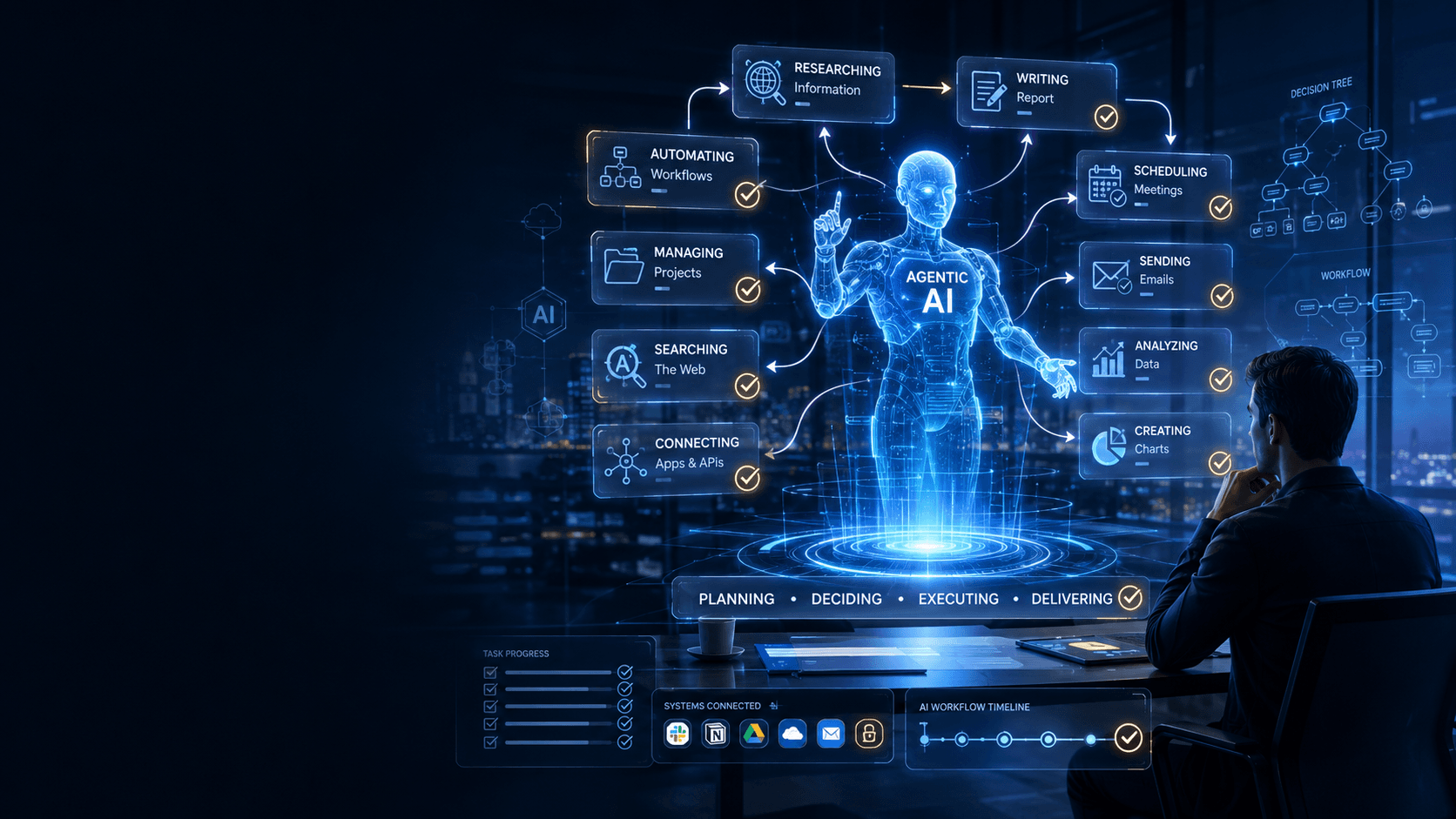
At its simplest, Agentic AI refers to artificial intelligence systems that can understand an objective, create a plan, execute multiple actions, and adapt until the goal is achieved.
Unlike traditional AI models that wait for every new prompt, Agentic AI continues working after receiving an objective.
Think of the difference this way.
Traditional AI
You ask:
"Write an email."
The AI writes it.
You then ask:
"Now summarize the meeting."
It summarizes.
Next, you ask:
"Schedule a follow-up."
Again, you need another prompt.
Every step requires human direction.
Agentic AI
Instead, you simply say:
"Handle today's client follow-ups."
The AI can:
Read new emails
Understand customer requests
Check internal databases
Draft responses
Schedule meetings
Update your CRM
Notify your team
Generate a report
All without requiring continuous prompting.
This ability to reason, plan, act, observe, and improve makes Agentic AI fundamentally different from previous AI systems.
Why Is It Called "Agentic"?
The word agentic comes from the word agent.
An agent is something that acts independently to achieve a goal.
Human employees are agents.
Robots can be agents.
Software can also become an agent if it can make decisions and perform actions on its own.
Traditional chatbots are reactive.
Agentic AI is proactive.
Instead of answering one question at a time, it focuses on completing an entire objective.
The Evolution of Artificial Intelligence
Understanding Agentic AI becomes much easier when you see how AI has evolved.
EraWhat AI Could DoHuman InvolvementTraditional SoftwareFollow fixed rulesVery HighRule-Based AIHandle predefined logicHighMachine LearningLearn from dataMediumGenerative AICreate contentMediumAgentic AIPlan and execute goalsLow
Traditional Software
Early software followed exact instructions written by programmers.
If something unexpected happened, it simply failed.
There was no learning or adaptation.
Machine Learning
Machine learning introduced systems capable of recognising patterns from data.
Instead of explicitly programming every rule, developers trained models using large datasets.
These systems became much better at tasks like:
Image recognition
Fraud detection
Recommendations
Spam filtering
However, they still solved only one specific problem.
Generative AI
Large Language Models changed everything.
Instead of recognising patterns alone, they could generate completely new content.
Generative AI could:
Write articles
Generate code
Summarize documents
Translate languages
Answer questions
Despite these impressive capabilities, generative AI remained largely reactive.
It responded.
It did not act independently.
Agentic AI
Agentic AI combines language understanding with planning, reasoning, memory, and software integration.
Rather than producing one response, it continues working until the assigned objective is complete.
This represents the transition from AI as a tool to AI as a collaborator.
How Does Agentic AI Work?
Although Agentic AI appears intelligent, it follows a structured workflow behind the scenes.
Most systems operate through a continuous loop.
Step 1: Receive a Goal
Instead of receiving detailed instructions, the AI receives a broad objective.
For example:
"Create a competitive analysis for our top five rivals."
The objective becomes the system's destination.
Step 2: Create a Plan
The AI breaks the objective into smaller tasks.
It may decide to:
Identify competitors
Visit their websites
Collect pricing
Analyze features
Compare strengths
Build charts
Write conclusions
Planning allows the AI to organise complex work into manageable steps.
Step 3: Choose the Right Tools
Unlike ordinary chatbots, Agentic AI can interact with external software.
Depending on the task, it may use:
Search engines
Databases
APIs
CRMs
Calendars
Email platforms
Spreadsheets
Coding environments
These tools extend the AI's capabilities far beyond simple conversation.
Step 4: Execute Actions
The AI begins performing tasks.
For example, it might:
Search the web
Read documents
Analyze spreadsheets
Run code
Update records
Send emails
Generate presentations
Each completed action moves the AI closer to the original objective.
Step 5: Observe the Results
Every action produces feedback.
Perhaps:
A webpage fails to load.
A database returns an error.
An API rejects a request.
Rather than stopping immediately, the AI evaluates what happened.
Step 6: Adapt Its Strategy
This is where Agentic AI becomes significantly more powerful than traditional automation.
Instead of failing outright, it asks:
Should I retry?
Is there another tool?
Can I solve the problem differently?
This adaptive reasoning enables it to navigate obstacles much like a human would.
Step 7: Complete the Goal
Once all planned tasks are finished, the AI evaluates whether the original objective has been achieved.
If necessary, it performs additional work until the result satisfies the user's request.
Agentic AI vs. Generative AI
Many people assume Agentic AI is simply another name for ChatGPT.
It isn't.
Generative AI focuses on creating content.
Agentic AI focuses on achieving outcomes.
Generative AIAgentic AIResponds to promptsPursues goalsGenerates text, images, or codeExecutes complete workflowsRequires continuous promptingOperates with minimal supervisionLimited decision-makingAutonomous planningUsually single-stepMulti-step execution
A useful analogy is this:
Generative AI is like a knowledgeable consultant.
It provides excellent advice but waits for your next question.
Agentic AI is like a capable project manager.
You define the goal, and it coordinates the work needed to reach it.
Real-World Examples of Agentic AI
Although Agentic AI sounds futuristic, many organisations are already experimenting with autonomous AI systems.
Customer Support
An AI agent receives a complaint about a delayed shipment.
Instead of forwarding the issue to an employee, it can:
Check shipping records
Verify delivery status
Determine refund eligibility
Process compensation
Send an apology email
Update customer records
The issue is resolved without constant human involvement.
Software Development
Developers increasingly use AI agents that can:
Read existing code
Identify bugs
Write fixes
Run automated tests
Debug failures
Prepare code for review
Rather than merely suggesting code snippets, these agents participate in the software development process itself.
Marketing
Marketing teams use AI agents to:
Research competitors
Analyze keyword opportunities
Generate content briefs
Monitor campaign performance
Produce weekly reports
Recommend optimizations
Hours of manual research can be completed in minutes.
Benefits of Agentic AI
Agentic AI isn't simply about making AI smarter—it's about making work more efficient. By automating complex, multi-step tasks, these systems allow individuals and businesses to focus on higher-value activities like strategy, creativity, and decision-making.
Here are some of the biggest advantages of Agentic AI.
1. Automates Complex Workflows
Traditional automation works well for repetitive tasks with predefined rules. However, real-world work is often unpredictable.
Agentic AI can handle dynamic workflows that involve decision-making, multiple software tools, and changing conditions. Instead of automating one task, it can automate an entire process.
For example, an AI agent managing employee onboarding could create accounts, schedule training sessions, send welcome emails, update HR records, and notify managers—all from a single instruction.
2. Boosts Productivity
Employees spend a significant portion of their day on administrative tasks such as writing emails, updating spreadsheets, scheduling meetings, and searching for information.
Agentic AI can perform many of these repetitive activities automatically, allowing professionals to spend more time on strategic work that requires human judgment and creativity.
3. Operates 24/7
Unlike humans, AI agents don't require breaks or sleep. They can continuously monitor systems, respond to customer inquiries, analyse data, and complete routine tasks around the clock.
This makes them particularly valuable for global businesses that operate across multiple time zones.
4. Makes Better Use of Data
Modern organisations generate enormous amounts of information, but much of it remains unused because analysing it manually is time-consuming.
Agentic AI can gather information from multiple sources, identify patterns, generate reports, and even recommend actions based on its findings.
5. Scales Easily
Once an AI agent has been configured for a specific workflow, it can often be deployed across multiple teams or departments with minimal additional effort.
Instead of hiring dozens of employees to perform repetitive digital tasks, organisations can use AI agents to handle routine work while people focus on complex decision-making.
Challenges and Risks of Agentic AI
Despite its enormous potential, Agentic AI is not without limitations. Businesses must carefully balance automation with governance, security, and human oversight.
Hallucinations
Like other large language models, Agentic AI can sometimes generate inaccurate information.
The difference is that an AI agent doesn't just produce incorrect text—it might act on that incorrect information.
For example, if an AI agent misunderstands an invoice or customer record, it could trigger the wrong payment or send inaccurate communications.
This is why verification mechanisms remain essential.
Security Risks
Agentic AI often requires access to business applications, databases, APIs, and sensitive customer information.
If these permissions are poorly managed, attackers could potentially exploit an AI agent to access confidential systems.
Organisations should apply strict access controls, encrypted credentials, and regular security audits before deploying autonomous agents.
Privacy Concerns
Many AI agents use long-term memory to improve future performance.
While this creates more personalised experiences, it also raises questions about how user data is stored, protected, and eventually deleted.
Compliance with privacy regulations such as GDPR and other regional laws remains essential.
Bias and Fairness
AI systems learn from historical data, which may contain human biases.
If left unchecked, these biases can influence decisions involving hiring, lending, customer support, or healthcare.
Regular monitoring and human review are necessary to ensure fair outcomes.
Human Oversight
Agentic AI is best viewed as a collaborator rather than a complete replacement for human expertise.
High-impact decisions—such as approving financial transactions, medical recommendations, or legal advice—should continue to involve human review.
The Future of Agentic AI
Many technology leaders believe Agentic AI will become the next major evolution in artificial intelligence.
Instead of interacting with dozens of separate software applications, users may simply assign objectives to AI agents.
For example:
"Plan our quarterly marketing campaign."
"Prepare this month's financial report."
"Book my business trip."
"Analyse our customer feedback and suggest improvements."
The AI agent would coordinate all the necessary tools, applications, and data sources to complete the task.
As reasoning models improve and integrations become more sophisticated, AI agents are expected to become common in workplaces across industries, including healthcare, finance, education, software development, manufacturing, logistics, and customer service.
Rather than replacing every job, Agentic AI is more likely to transform how work gets done. Routine digital tasks will increasingly be automated, while humans focus on creativity, leadership, relationship-building, and complex problem-solving.
Frequently Asked Questions
Is Agentic AI the same as ChatGPT?
No. ChatGPT is primarily a generative AI system designed to answer questions and generate content. Agentic AI extends these capabilities by planning, making decisions, using external tools, and completing multi-step objectives with minimal human guidance.
Can Agentic AI make decisions on its own?
Yes—but only within the permissions, goals, and constraints defined by its developers or users. It is autonomous within its assigned environment, not independently conscious or self-aware.
Does Agentic AI replace human workers?
Not entirely. Agentic AI is designed to automate repetitive and administrative work, allowing people to focus on tasks requiring creativity, empathy, ethical judgment, and strategic thinking.
Which industries will benefit the most?
Almost every industry can benefit from Agentic AI, but early adoption is particularly strong in software development, customer service, finance, healthcare, marketing, cybersecurity, logistics, and enterprise operations.
Is Agentic AI safe?
It can be safe when deployed responsibly. Organisations should implement human oversight, strong security controls, access restrictions, auditing, and governance policies to reduce potential risks.
Key Takeaways
Agentic AI is the next evolution of artificial intelligence, moving beyond content generation to autonomous task execution.
Unlike traditional AI, it can plan, reason, use software tools, adapt to changing situations, and work toward completing a goal.
Businesses are already using AI agents for customer support, software development, marketing, research, and workflow automation.
The technology offers significant productivity gains but also introduces challenges around security, privacy, accuracy, and governance.
As AI continues to evolve, Agentic AI is expected to become an essential digital collaborator across nearly every industry.
Conclusion
Agentic AI marks a significant shift in the evolution of artificial intelligence. Instead of acting as a passive assistant that waits for prompts, it behaves like an autonomous digital teammate capable of planning, executing, and adapting to achieve meaningful outcomes.
While the technology is still developing, its real-world impact is already evident. Organisations are using AI agents to automate complex workflows, improve customer experiences, accelerate software development, and make faster, data-driven decisions.
For individuals, understanding Agentic AI today means being better prepared for tomorrow's workplace. Whether you're a business leader, developer, marketer, or student, learning how autonomous AI systems operate will become an increasingly valuable skill in the years ahead.
The future of AI isn't just about generating better answers—it's about building intelligent systems that can independently turn ideas into action.