Tech
What Is Blockchain? (Explained Simply for Beginners)
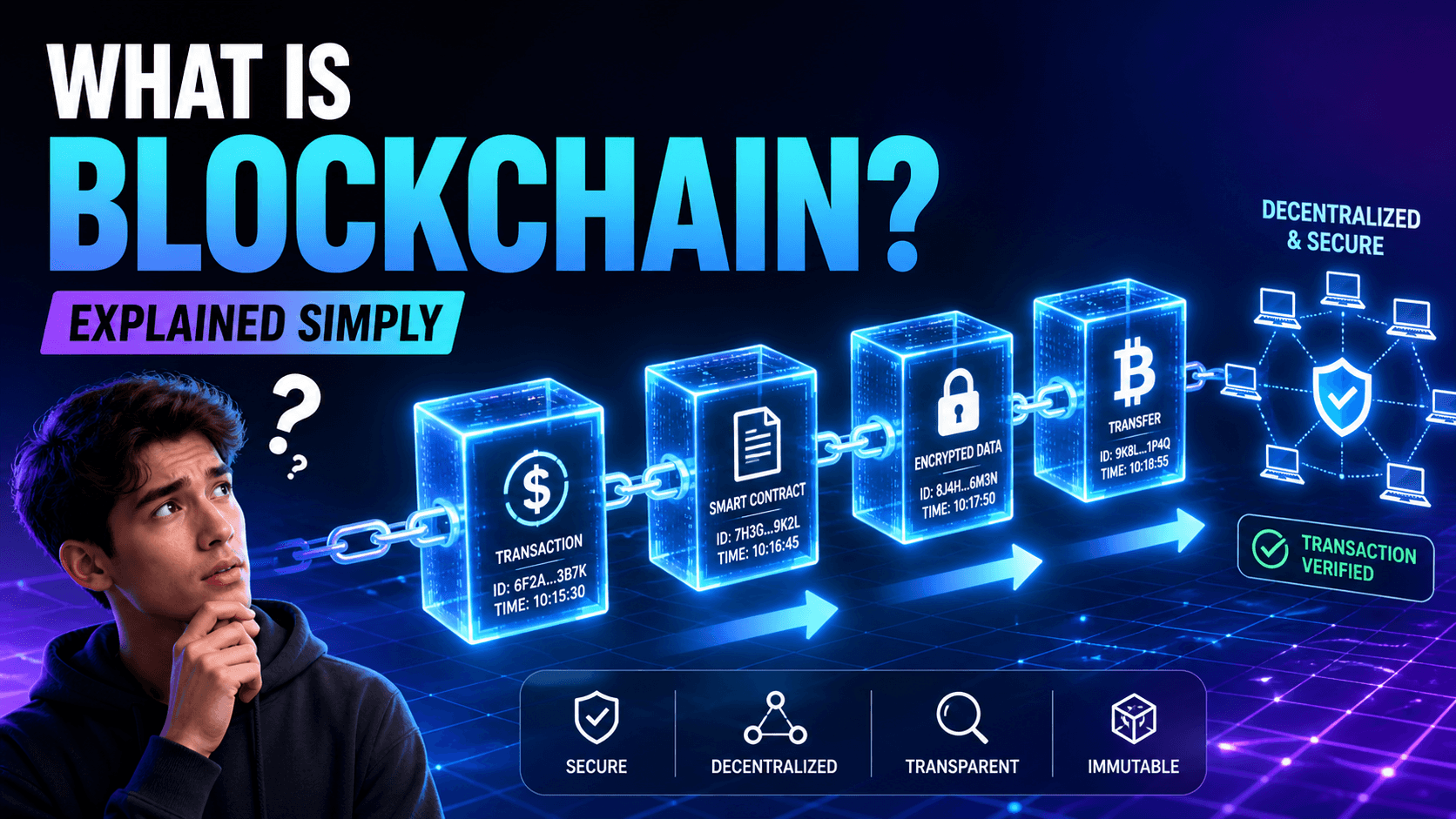
Blockchain is a shared digital record kept by thousands of computers at once, instead of one company. That setup makes it secure, transparent, and almost impossible to fake — so people can swap money or data without a bank or middleman in between.
Introduction: Why Blockchain Matters More Than You Think
Picture sending money to a cousin in another country. You wait 3–5 days. You pay fat fees. The bank decides when it goes through.
Now picture the same transfer landing in seconds, costing almost nothing, with no bank involved at all.
That's not just a speed upgrade. It's a different way of doing trust online.
Blockchain is what makes it work. And here's the good news — you don't need to code or have a finance degree to get it.
This guide walks you through it step by step. No jargon. No filler.
What Is Blockchain? (Simple Definition)
Here's the one-line version:
Blockchain is a shared digital notebook that records transactions across thousands of computers at the same time.
No single company owns the notebook. Everyone on the network keeps a copy.
Which means:
Nobody can sneak in and edit old records
Everyone is looking at the same version
Trust isn't required — it's built in
That solves a huge problem: how do you verify anything online without a referee in the middle?
Why Blockchain Exists (The Problem It Solves)
For a long time, we've leaned on middlemen for everything.
Banks for money
Governments for records
Companies for storing our data
They get the job done, but they come with baggage:
Delays
Fees
Mistakes and fraud
One server goes down, and everything stops
Blockchain swaps all that out for distributed trust. The crowd verifies things together instead of one boss calling the shots.
The Easiest Way to Understand Blockchain (Analogy)
Let me make this concrete.
The "Neighbourhood WhatsApp Group" Analogy
Picture 30 neighbours in a WhatsApp group tracking who owes whom.
There's no accountant. Instead:
Everyone keeps their own log of payments
Every new payment gets posted in the group
Everyone checks it before it counts
The group runs on three rules:
1. No One Can Change History
Once a payment is posted, it's locked. Try to edit it later, and the group calls you out. The change gets rejected.
2. The System Never Fails
Five neighbours leave the group? No problem. The other 25 still have the full record. Nothing is lost.
3. Everything Is Transparent
Every payment is visible to all 30 people. No backroom edits. No funny business.
That's blockchain. Just stretched to a global scale.
How Blockchain Works (Step-by-Step)
Now the real version.
Step 1: A Transaction Is Requested
Someone kicks things off:
Sending money
Signing a contract
Recording data
Step 2: The Request Is Broadcast
It goes out to a worldwide network of computers, called nodes.
Step 3: The Network Verifies It
The nodes ask:
Is the sender real?
Do they actually have what they're sending?
This is the part a bank used to do.
Step 4: Transactions Form a "Block"
Verified transactions get bundled into a block. Think of it as a fresh page in a ledger.
Step 5: The Block Is Added to the Chain
Each block is locked to the previous one with a unique digital fingerprint called a hash. Block by block, you get a chain. Hence the name blockchain.
Try to tamper with one block, and the whole chain breaks. The network spots it instantly and rejects the change.
The 4 Key Features of Blockchain
Four properties do the heavy lifting.
1. Decentralisation
Nobody is in charge. Thousands of computers share the load, so there's no single point of failure.
2. Transparency
Every transaction is out in the open. That's how you build trust without a middleman.
3. Security
Data is locked down with cryptography and verified by the network. To break it, you'd need to overpower most of the network at once. Good luck with that.
4. Immutability
Once something is on the chain, it stays. You can't edit or delete — you can only add new entries. That gives you a permanent, reliable history.
Blockchain vs Traditional Databases
Feature Traditional System Blockchain Control Central authority Distributed network Data Editing Can be changed Permanent Trust Requires intermediaries Built into system Failure Risk High (single point) Very low
Blockchain is the right tool when:
Multiple parties don't trust each other
Transparency is non-negotiable
Security matters more than raw speed
Real-World Uses of Blockchain
Blockchain isn't just crypto. It's already showing up in plenty of places.
1. Money and Payments
Quick international transfers
Tiny fees
No banks needed
2. Supply Chain Tracking
Companies use it to track:
Where food came from
How a shipment was handled
Whether a product is genuine
It cuts down on fraud, fakes, and contamination.
3. Voting Systems
Blockchain can:
Block vote tampering
Make results transparent
Enable secure digital voting
4. Digital Ownership
Used for:
NFTs (digital assets)
Music rights
Creator royalties
Creators get to actually own — and earn from — their own work.
Common Blockchain Myths (Debunked)
Myth 1: Blockchain = Bitcoin
Wrong.
Blockchain is the tech
Bitcoin is one app built on it
Easier way to think about it:
Blockchain = the internet
Bitcoin = one website
Myth 2: It's Anonymous and Used by Criminals
Actually, the opposite. Every transaction is public and trackable, which makes shady activity easier to trace, not harder.
Myth 3: It's Unhackable
The core system is rock solid. But the stuff built on top — apps, wallets, exchanges — can still get hacked.
Myth 4: It's Only for Tech Experts
Not anymore. Today's tools are built for regular people. You don't need to write a single line of code to use them.
Why Blockchain Is a Big Deal
Here's the real shift:
Blockchain removes the need for trust between two parties.
Instead of trusting:
Banks
Governments
Corporations
You trust:
Math
Code
The agreement of thousands of computers
People call it a trust revolution for a reason.
Limitations of Blockchain (Important to Know)
It's not magic. There are real trade-offs.
1. Slower Than Traditional Systems
Getting thousands of computers to agree on something takes time.
2. Energy Consumption
Some blockchains burn through serious amounts of electricity.
3. Complexity
It's still a steep learning curve for newcomers.
4. Regulation Uncertainty
Governments are still figuring out the rulebook.
When Should You Care About Blockchain?
Pay attention if you care about:
Digital money (crypto)
Online privacy
Investing
Where tech is heading
Decentralised apps (Web3)
Even if you never touch it yourself, it's already reshaping:
Finance
Identity
Ownership
Beginner-Friendly Summary
The whole thing in five bullets:
Blockchain is a shared digital record
It lives on many computers, not one
No one is in charge
Past data can't be edited
Anyone can verify transactions
That's the foundation. Everything else is just built on top.
Frequently Asked Questions (FAQ)
Is blockchain the same as cryptocurrency?
Nope. Crypto runs on blockchain, but blockchain does plenty of other things too.
Is blockchain safe?
The core tech is very safe. The apps and exchanges around it — less so.
Can blockchain be hacked?
Cracking the blockchain itself is brutally hard. The apps built on top of it? Those have been hacked plenty of times.
Do I need to understand coding?
Not at all. You can use blockchain apps the same way you use any other app on your phone.
Final Thoughts: Should You Learn Blockchain?
Yes. This isn't a fad.
It's a real shift in how digital systems work.
The internet changed how we share information. Blockchain is changing how we:
Move value
Build trust
Own digital things
The sooner you get the basics, the better placed you'll be for whatever comes next.
Next Step
Want to go beyond theory?
Try a beginner-friendly crypto wallet or a simple blockchain app
Read up on real use cases in an industry you actually care about
Dig into smart contracts and decentralised apps next
Getting blockchain today is a bit like getting the internet in 1995. You don't need to master it. But ignoring it would be a mistake.
Newsletter
Get New Posts In Your Inbox
No spam. Just practical reads on AI, Finance, and Tech.
By subscribing, you agree to get occasional emails. Every one has a one-click unsubscribe link.