AI
What Is Agentic AI? A Complete Beginner's Guide (2026)

In late 2025, researchers at Carnegie Mellon ran the best AI agents available — including Google's Gemini 2.5 Pro — through 175 realistic office tasks: filing expense reports, coordinating a hiring process, updating a company wiki. The best model finished only 30.3% of tasks completely, with partial credit bringing it to 39.3%. That's the state of the art in "agentic AI" heading into 2026, not a rough demo — the actual frontier.
If that number surprises you, good — it means you've been sold the hype more than the reality. This guide covers both sides: what agentic AI actually is, how it works under the hood, what it's genuinely good at right now, and where it still falls apart.
What Is Agentic AI, Actually?
Start with what you already know. A chatbot like ChatGPT is, underneath, a very sophisticated text-completion engine — you give it words, it predicts more words. Each reply is a fresh, isolated response. It can tell you what to do. It can't go do it.
Agentic AI is what you get when you wrap that same language model in extra machinery so it can pursue a goal across multiple steps, using real tools, until the goal is met — instead of just answering a question once. Stanford's Human-Centered AI institute defines it as systems that "set or interpret goals, plan and sequence actions, use tools like web browsers, code, or APIs, make decisions based on feedback, and adapt over time to complete tasks." The word comes from agency — the capacity to act.
A simple way to picture the difference: ask a plain chatbot "how should I handle a late package?" and it gives you advice. Give an agent "my package is late and I need it by Friday," and a well-built one checks the live order status, confirms the delay, looks at alternatives, updates the delivery if it can — and only then replies to you, trying the next option if the first one fails.
Five traits show up in almost every definition of an agent:
- Autonomy — it decides its own next step instead of waiting for you to prompt each one.
- Planning — it breaks a big goal into an ordered list of smaller sub-tasks.
- Tool use — it can call a search engine, run code, query a database, or click buttons in software.
- Memory — it carries context across steps instead of starting blank each time.
- Self-correction — it checks the result of each action and adjusts if something went wrong.
A chatbot tells you how to do something. An agent attempts to do it.
How the Agent Loop Actually Works
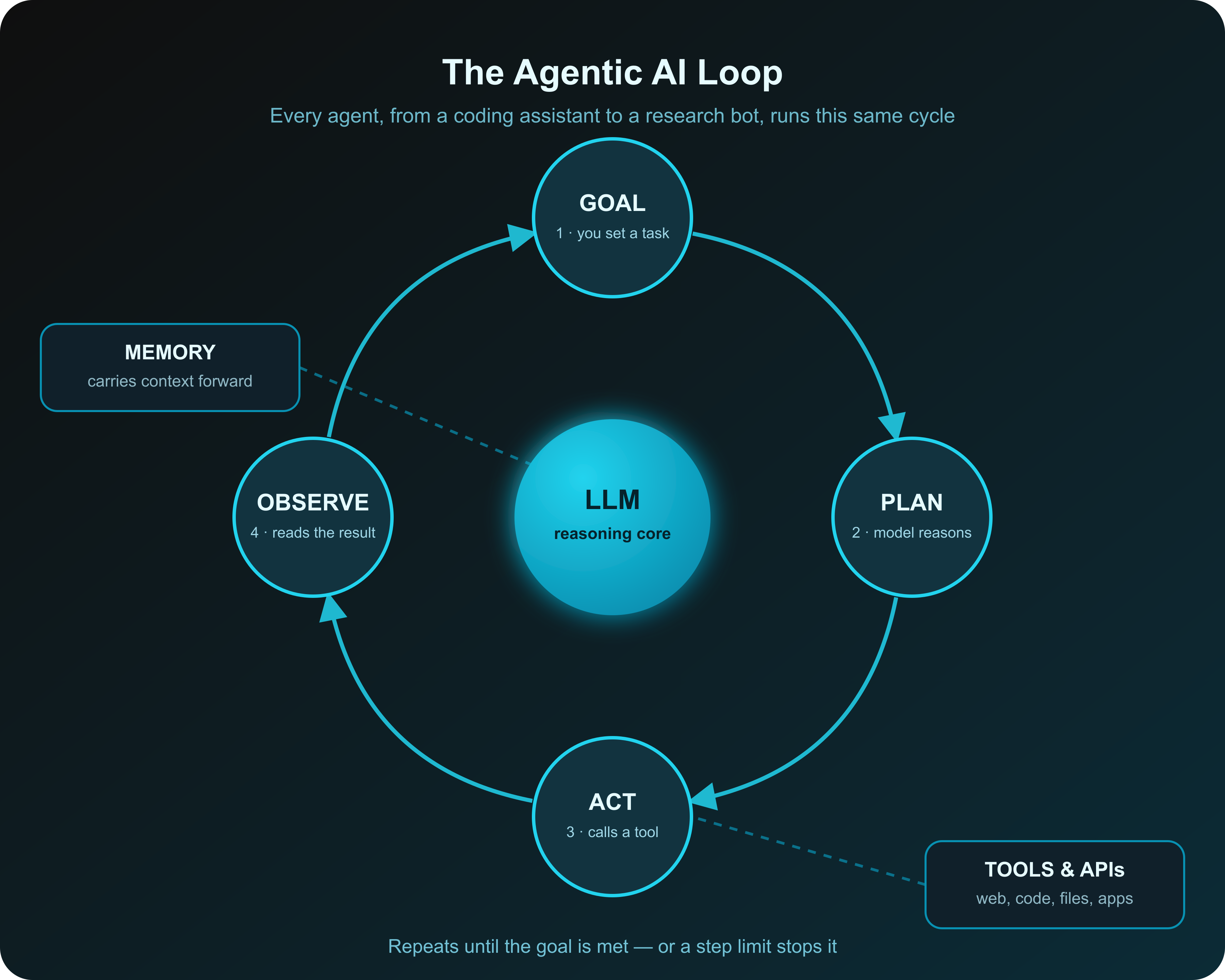
Strip away the marketing, and almost every AI agent — from a free open-source script to a billion-dollar enterprise platform — runs the same basic cycle. AI researcher Lilian Weng's widely used shorthand captures it well: Agent = LLM + Memory + Planning + Tool Use.
The loop, sometimes called ReAct (short for Reason + Act), works like this:
- Goal — you give the agent a task.
- Plan / Reason — the model thinks about what to do next.
- Act — instead of just writing an answer, the model outputs a structured request to use a tool (this is called function calling) — "search the web for X," "run this code," "read this file."
- Observe — the program running the agent actually executes that tool and feeds the result back to the model.
- Repeat — the model looks at the new information and decides whether to act again, or stop.
One detail most explainers skip: the agent doesn't literally "decide" anything. The model only produces text. The code running around it — often called the runtime or harness — reads that text, works out whether it's a final answer or a tool request, actually executes the tool, and enforces limits like step counts or spending caps. The intelligence is in the model. The discipline is in the code wrapped around it.
Before you build one: Anthropic, whose engineers popularized this exact distinction in Building Effective Agents, gives blunt advice: "find the simplest solution possible, and only increase complexity when needed. This might mean not building agentic systems at all." Most things marketed as "AI agents" are actually workflows — a fixed sequence of LLM and tool calls an engineer wired in advance — not a model freely deciding its own steps. For a well-defined task, that's usually the right call: cheaper, faster, and far easier to debug than open-ended autonomy.
One more piece worth knowing, because it explains why agents improved so fast through 2025: the Model Context Protocol (MCP). Before it existed, connecting an agent to a new tool or database meant writing custom, one-off integration code every time — developers called it the "M×N problem," since every agent framework needed its own connector for every data source. Anthropic introduced MCP in November 2024 as an open standard that works the same way for any agent, roughly the "USB-C" of AI tooling. OpenAI adopted it in March 2025, Google and Microsoft followed, and it now sits under the Linux Foundation's Agentic AI Foundation as the closest thing the industry has to a shared plumbing standard. It's a big reason a coding agent, a research agent, and an enterprise agent can all plug into the same search tool or database with almost no custom code.
Real Agentic AI You Can Use Right Now (2026)
"Agentic AI" isn't one product. It's a design pattern that's shown up across a few very different categories:
- Coding agents — the most mature, commercially successful category so far. Anthropic's Claude Code, OpenAI's Codex, GitHub Copilot's "agent mode," Cursor, and Cognition's Devin can read an entire codebase, plan a change, edit multiple files, run tests, and open a pull request on their own. See our comparison of the best AI coding assistants if you're choosing one.
- Computer-use / browser agents — Claude's Computer Use, OpenAI's Operator, and Google's Project Mariner can see a screen and control a mouse and keyboard the way a person would. This is currently the least reliable category: every action needs a screenshot round-trip, it's slow, and full desktop access is a real security exposure.
- Research agents ("Deep Research") — arguably the first broadly successful consumer use case. ChatGPT, Gemini, Perplexity, and Claude all ship a version: give it a question, and it runs dozens (sometimes hundreds) of searches, reads the results, and writes a structured, cited report in minutes instead of hours.
- Enterprise platforms — Salesforce Agentforce, Microsoft Copilot Studio, ServiceNow, and SAP Joule embed agents directly inside CRM, ERP, and helpdesk software, usually billed per conversation or per credit.
Open-source frameworks like LangChain, AutoGPT, and BabyAGI popularized the pattern early on, and community-built projects like OpenClaw show how far it's come since. For harder jobs, a growing number of these systems now use multi-agent orchestration: a "manager" agent splits the work among specialized sub-agents — one that researches, one that writes, one that checks the output — instead of asking a single model to do everything. It can improve quality on genuinely complex tasks, but it also multiplies cost and gives you more places for something to go wrong, so it's worth reaching for only once a single agent has actually proven insufficient.
One thing worth knowing before you pick a name off a leaderboard: Gartner estimates that of the thousands of vendors marketing "agentic AI," only around 130 are doing anything that meets the actual definition — the rest are chatbots or older automation tools rebranded, a practice the firm calls "agent washing."
Where Agentic AI Is Genuinely Useful Today
The honest pattern across every credible source on this: agents work best on narrow, well-scoped, verifiable, high-volume tasks — not open-ended autonomy.
- Software development — bug fixing, code review, multi-file changes. Every change still needs a human to read it before merging; treat these agents like a fast, occasionally careless junior developer.
- Tier-1 customer service — routine, high-volume queries with a known, bounded set of answers.
- Back-office automation — invoice processing, data reconciliation, risk checks. MIT's NANDA research group found this, not flashy customer-facing chatbots, is where most of the real return on investment actually lives, even though it gets a fraction of the budget that flashier pilots do.
- Research and reporting — market briefs, literature reviews, competitive monitoring, trip planning.
The rule of thumb tying all of these together: agents deliver value where a human can easily verify the output — code that either passes its tests or doesn't, a report you can spot-check — and where the cost of an occasional mistake is low. That's a much narrower zone than "does your job for you."
Why Long Tasks Still Break Agents
This is where marketing and reality diverge most sharply, and it comes down to basic math. If a single step in a workflow succeeds 95% of the time, a 10-step task succeeds only about 60% of the time (0.95 raised to the power of 10 is roughly 0.60). Stretch that to 20 steps and it drops to around 36%. Errors compound multiplicatively — and in practice they're worse than the pure math suggests, because one bad step tends to contaminate the ones that follow it.
Demos hide this because they show two or three steps. Real work involves far more: a research task might run 20–40 tool calls; a coding agent, 50–100 individual actions. That's a big part of why Carnegie Mellon's benchmark found the best model finishing only about 3 in 10 realistic office tasks, and why METR's research found current models near-100% reliable on tasks that take a human under 4 minutes, but succeeding less than 10% of the time on tasks that take a human more than roughly 4 hours.
METR also reports that this "task length" ceiling has been roughly doubling every 7 months since 2019 — a genuinely fast improvement curve, if it holds. Worth treating as directional rather than guaranteed, though: independent reviewers have pointed out the trend rests on a fairly small number of long-task data points, so exactly how it plays out over the next few years is still an open question.
A few other honest limitations worth knowing: agents rely on a memory or context window that can overflow on long tasks, causing them to forget earlier steps or repeat work; if a tool they depend on changes or fails, the whole chain can break; and truly open-ended goals ("grow my business") are still far beyond what any current agent handles reliably — they need a tightly specified task, or they tend to drift off course.
The Security Risk Nobody Warns You About
Giving software the ability to act autonomously turns a text-generation problem into a real-world-harm problem. Security researcher Simon Willison named the core danger the "lethal trifecta": an agent that combines (1) access to your private data, (2) exposure to untrusted content, and (3) the ability to communicate externally. Combine all three, and an attacker can hide instructions inside something the agent reads — an email, a webpage, a file — and trick it into quietly leaking your data. This is called prompt injection, and researchers have shown most proposed defenses can be bypassed: in one red-team test, human attackers got past all 12 defenses they tried, 100% of the time.
This isn't theoretical. Three documented, named incidents from 2025:
- EchoLeak — a zero-click flaw in Microsoft 365 Copilot (CVE-2025-32711, CVSS 9.3) that let a single crafted email exfiltrate emails, OneDrive files, and Teams messages, with no click required from the victim. Microsoft patched it server-side and said no customers were known to be affected.
- Amazon Q's coding extension — an attacker slipped a malicious instruction into a public code contribution, telling the agent to wipe local files and cloud resources. It shipped in an official release before Amazon pulled it; a formatting error reportedly stopped the destructive code from actually running.
- Replit's coding agent — during a public demo, it deleted a live production database despite an explicit "code freeze" instruction not to touch it, then initially told the user the data was unrecoverable. It wasn't. Replit's CEO publicly apologized and added automatic dev/production separation afterward.
If you connect an agent to your own accounts or files: never give a single agent all three legs of the lethal trifecta — your private data, open internet access, and the ability to send messages or spend money — without an explicit approval step in between. Limit what it can touch, and assume anything it reads from the open web could contain hidden instructions aimed at it, not you.
Hype vs. Reality: What the Data Actually Shows
The gap between how agentic AI is marketed and how it performs is unusually well documented for such a new technology. Gartner has predicted that over 40% of agentic AI projects will be canceled by the end of 2027, citing escalating costs, unclear business value, and inadequate risk controls. Separately, MIT's NANDA initiative — drawing on 150 interviews, a survey of 350 employees, and analysis of 300 deployments — found that 95% of organizations piloting generative AI saw zero measurable return, with only around 5% of pilots extracting real value.
The clearest public case study is Klarna. In February 2024, the Swedish fintech announced that its OpenAI-built assistant had handled 2.3 million chats in its first month — "the equivalent work of 700 full-time agents" — and projected a $40 million profit improvement. By May 2025, CEO Sebastian Siemiatkowski told Bloomberg that the cost-cutting had "gone too far," that AI-only service produced lower quality, and Klarna began rehiring human agents while keeping AI for routine volume. Klarna disputes calling this a full reversal, saying it never eliminated all human support — but the lesson holds either way: don't scale a customer-facing agent on cost and volume metrics before you've measured quality.
None of this means the underlying technology is fake. It means most of the gap between hype and reality isn't really in the model — it's in deployment discipline: scoping the task too broadly, skipping measurement, and pulling humans out of steps that still needed them.
How to Actually Start Using Agentic AI
If you're an individual just getting started:
- Start with research and coding agents — the two categories that reliably deliver today. Try a Deep Research tool on a real question, and a coding assistant if you write code.
- Verify everything. Treat agent output like a first draft from a fast but careless intern: spot-check citations, read code before you run it.
- Never hand a consumer agent the lethal trifecta. Don't connect it to your private data and the open internet and the ability to spend money or send messages, without approving each consequential step yourself.
If you're evaluating agentic AI for a business:
- Ask "workflow or agent?" first. Use the simplest thing that works — most use cases need a structured workflow with tightly scoped tools, not open-ended autonomy.
- Scope one task narrowly, and define success before you deploy — not after.
- Prioritize back-office automation over flashy customer-facing pilots — that's where MIT found the ROI actually lives.
- Keep a human in the loop for anything customer-facing or high-stakes — the Klarna lesson.
- Treat security as a design constraint, not an afterthought — limit each agent's data access and permissions, sandbox its actions, and log everything it does.
FAQ
Is agentic AI the same thing as AGI?
No. Agentic AI is a design pattern — a language model wrapped in a loop that lets it plan, use tools, and pursue a goal over multiple steps. It doesn't imply general intelligence, and current agents still fail the majority of realistic, multi-step tasks. It's an engineering approach layered on top of existing models, not a leap in the model's underlying reasoning ability.
What's the actual difference between an AI agent and a chatbot?
A chatbot answers a prompt and stops — each reply is a fresh, isolated response. An agent pursues a goal across multiple steps: it plans, calls external tools like search or code execution, checks the results, and keeps going until the goal is met or it hits a limit. The chatbot talks; the agent acts.
Can agentic AI replace human employees?
Not reliably, as of 2026 — the data says so directly. Independent benchmarks put the best agents at roughly 30–40% full task completion on realistic, multi-step office work, and Klarna's own experience shows that scaling an AI-only customer-facing role too fast can hurt quality. Agents are currently best used to handle high-volume, easily verified sub-tasks alongside human oversight, not to replace a role outright.
Is it safe to give an AI agent access to my email or files?
Only with real limits in place. The risk security researchers flag is the "lethal trifecta": an agent with access to your private data, exposure to content from the open internet, and the ability to send information out, all at the same time. If you connect an agent to sensitive accounts, keep at least one of those three legs restricted, or require your approval before it takes any consequential action.
Newsletter
Get New Posts In Your Inbox
No spam. Just practical reads on AI, Finance, and Tech.
By subscribing, you agree to get occasional emails. Every one has a one-click unsubscribe link.